
Browser support
The Lab needs two browser APIs to reach the arm: Web Serial for USB and Web Bluetooth for wireless. Only Chromium-based browsers implement them.
| Browser | Read the course | Connect over USB | Connect over Bluetooth |
|---|---|---|---|
| Chrome, desktop | yes | yes | yes |
| Edge, desktop | yes | yes | yes |
| Brave, Opera, Vivaldi, desktop | yes | yes | yes |
| Chrome on Android | yes | no | yes, with caveats |
| Firefox, any platform | yes | no | no |
| Safari, any platform | yes | no | no |
| Any browser on iOS or iPadOS | yes | no | no |
When the API is missing, the USB and Bluetooth tiles in the connection dialog are disabled and marked Chrome browser required. Nothing is broken — the browser simply has no way to open a serial port.
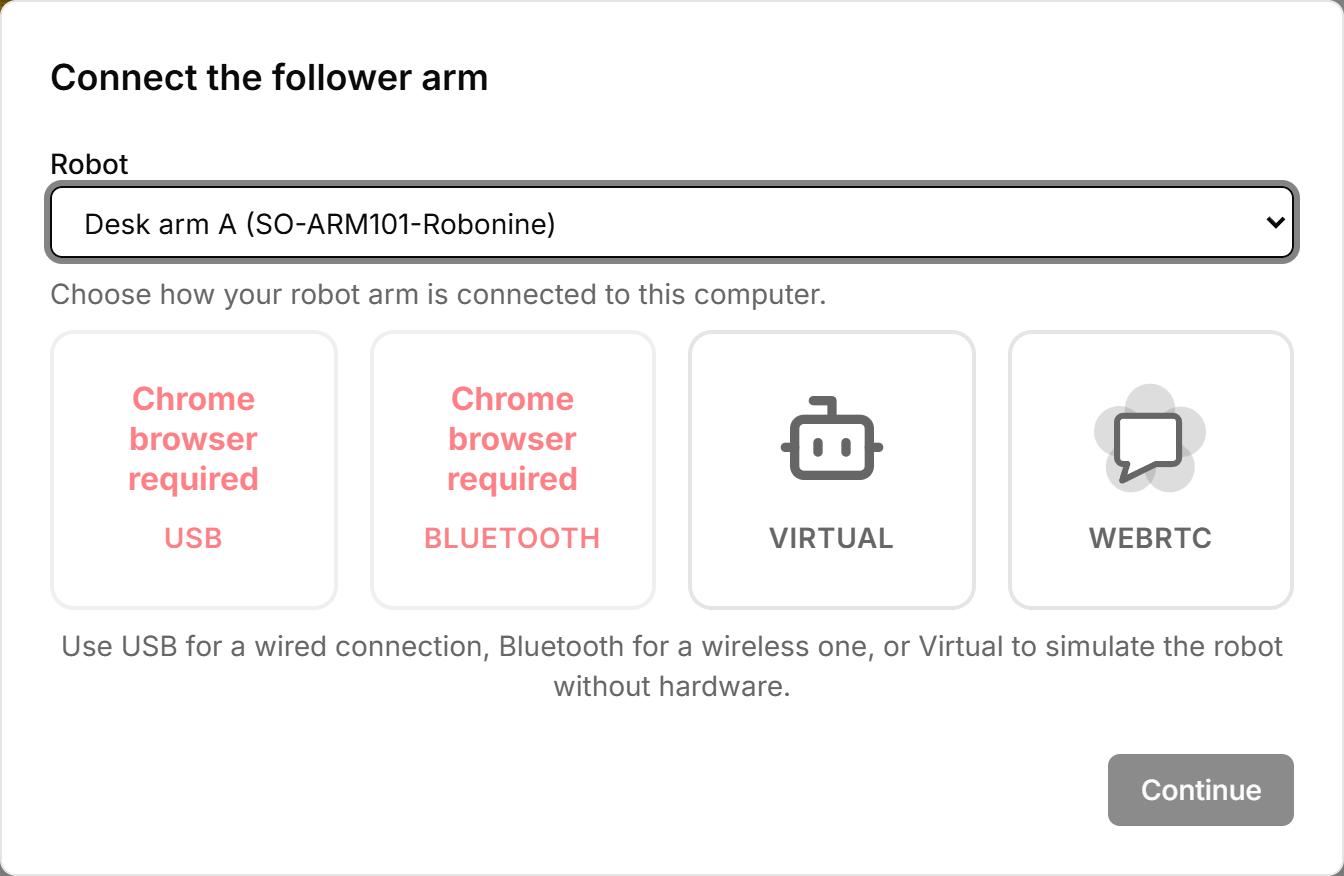
Everything that does not touch hardware works anywhere: the reading, the 3D viewport, the virtual arm, and the computer-vision modules against their virtual scene.
In-app browsers
Links opened from Instagram, Facebook, LinkedIn, TikTok or WhatsApp load inside those apps' own browsers, where Google sign-in is blocked and the hardware APIs are absent. The Lab detects this and offers Open in your browser; on iOS, use the ••• menu and choose Open in browser.
Managed and school machines
Two policies commonly get in the way, and both look like a broken app:
- A fleet standardised on Firefox. No amount of configuration will make it connect to an arm.
- Device permissions disabled by enterprise policy. The port chooser never appears, or appears empty, on every managed machine while a personal laptop works fine.
Test on a real managed machine, under a normal user account, before a course starts. See Classroom troubleshooting.
Bluetooth specifics
The arm's wireless adapter advertises the Nordic UART Service. The browser must have Bluetooth permission, and the operating system's adapter must be on — if it is off, the tile turns amber and reads Bluetooth is off, then goes live by itself once you enable it.
Linux users may need their account added to the group that owns serial devices before the port appears.
